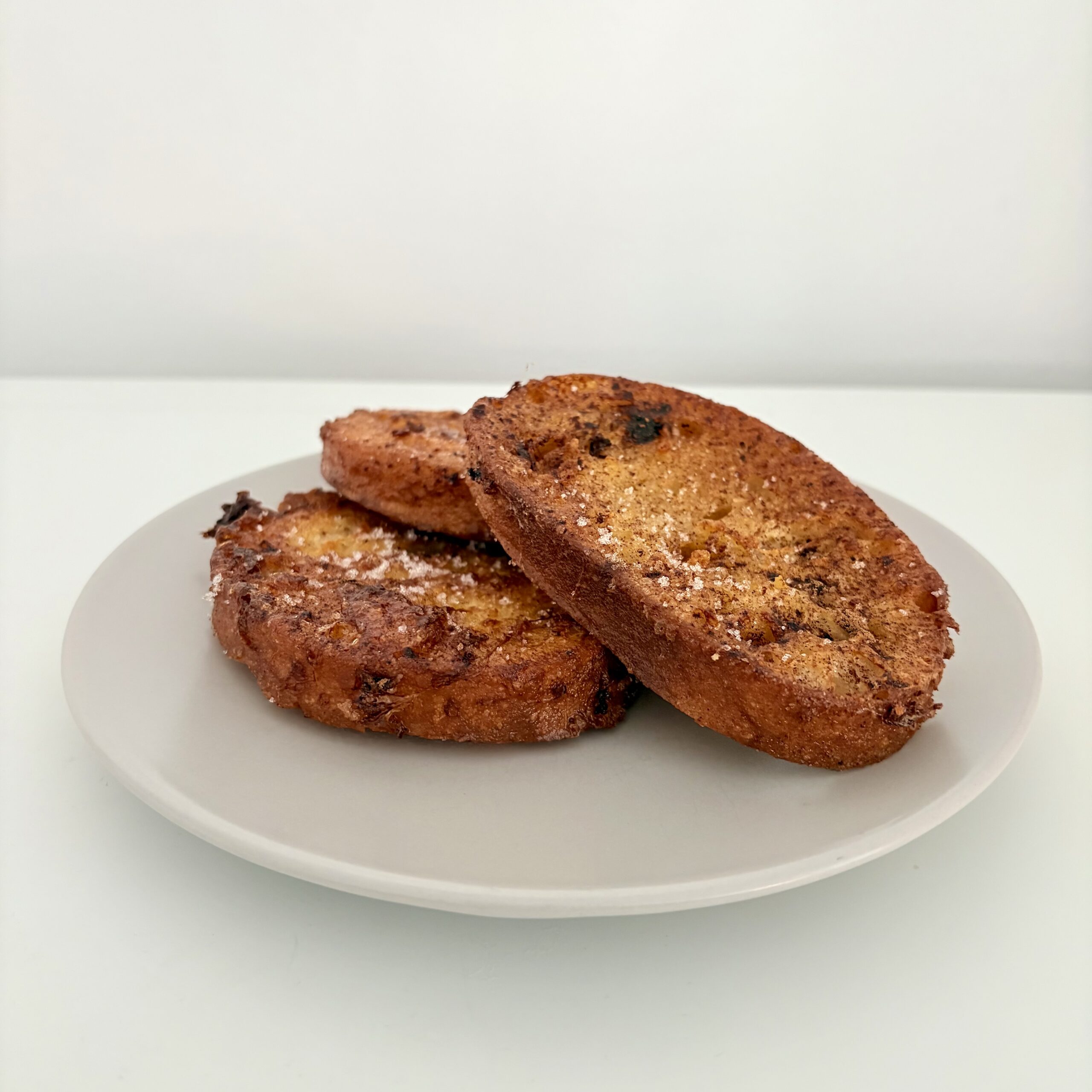
In Spain, we call them torrijas, and they are usually eaten at Easter. For me, the best moment to make torrijas is when spring has just begun: the days are longer and sunnier, but it’s still too cold to have breakfast in the garden. Every year, they bring back the same memory: visiting my brother in Latvia at Easter, when he asked me to make them for him and his host family. When his host mum came into the kitchen, her eyes lit up and she said, “I know this dish, my mum used to make it.” Unfortunately, I don’t remember what she called it in Latvian.
In Brazil and Portugal, they are called rabanadas and are usually eaten at Christmas. It was a complete cultural shock to eat them in the heat of the Brazilian summer when I last spent Christmas there.
When I make them and people ask what they are, I say, “It’s just like Spanish French toast.” I’ve recently learned that, similar to Russian salad, French people don’t call it French toast but pain perdu, often made with brioche.
Torrijas seem to have the potential to promote cross-cultural understanding. Anywhere you have bread, milk, and eggs, this humble dish can spark joy through childhood memories and traditions. Some people make them with oil, others with butter.
What’s so universal about it? Some alternative names—Poor Knights in English and Arme Ritter in German—suggest that we should see the dish from a very humble point of view. What’s more human than knowing no food should go to waste and finding a way to transform yesterday’s bread into today’s comfort food?
Beyond regional variations, every household seems to give its own touch to this common dish. It’s very likely that, if you ask a random person, they’ll say their mum made the best torrijas. I often see them at brunch places (served as French toast with whatever topping happens to be viral), but in Spain, it’s a very common dessert, often soaked in honey. Still, there seems to be broad agreement that a sugar-and-cinnamon coating is a safe way to go.
When you eat them, pay attention to the details that make a torrija, a rabanada, or French toast—you name it—unique. Check whether it’s deep-fried (for me, more traditional), air-fried, or baked (usually considered the healthier option, though I haven’t verified that myself).
In my case, I tend to keep it simple and go for a sugar–cinnamon topping. It has always made sense to me that it should be something you can grab with your fingers (since Easter also means the first excursions and outdoor meals of the year), so I try to keep a hard, crunchy edge. Experience has also taught me that warming up the milk helps create that puddiny consistency in the core and blends the flavors, while some orange peel balances the sweetness.
Step by step (roughly):
• Warm some milk with a bit of sugar, vanilla extract, a cinnamon stick, and an orange or lemon peel.
• Let it simmer for 5 minutes, then leave it to cool enough so you can soak the bread with your fingers.
• Thoroughly soak the bread, then gently squeeze it before dipping it in the egg wash.
• Deep-fry in hot oil (ideally olive oil).
• Sprinkle some sugar and extra ground cinnamon on top.
The savory cousin
Being born in Colombia, I had to see whether there was a version of torrijas there. In Colombia, bread as we know it in Europe isn’t very common. Besides American-style loaf bread (for sandwiches), baguette, or brioche-type bread, most other breads are considered a bit fancy (don’t you dare challenge a corn arepa made by the lady at the street corner). After a first round of asking, there didn’t seem to be an exact version of torrijas in Colombian cuisine. Case closed, I thought. Little did I know…
A quick search led me to what might be the Colombian cousin of torrijas: changua. Changua is a soup made with a water-and-milk broth, egg, cilantro, and bread (or arepa), usually eaten at breakfast. I know changua from cold mornings in the high Colombian Andes, when it warms you from the inside out. While some might argue that a savory soup is far from a sweet torrija, the fundamental principle of transforming stale bread into a comforting dish remains.

Adorei , a história da RABANADA
Interesante nao e?