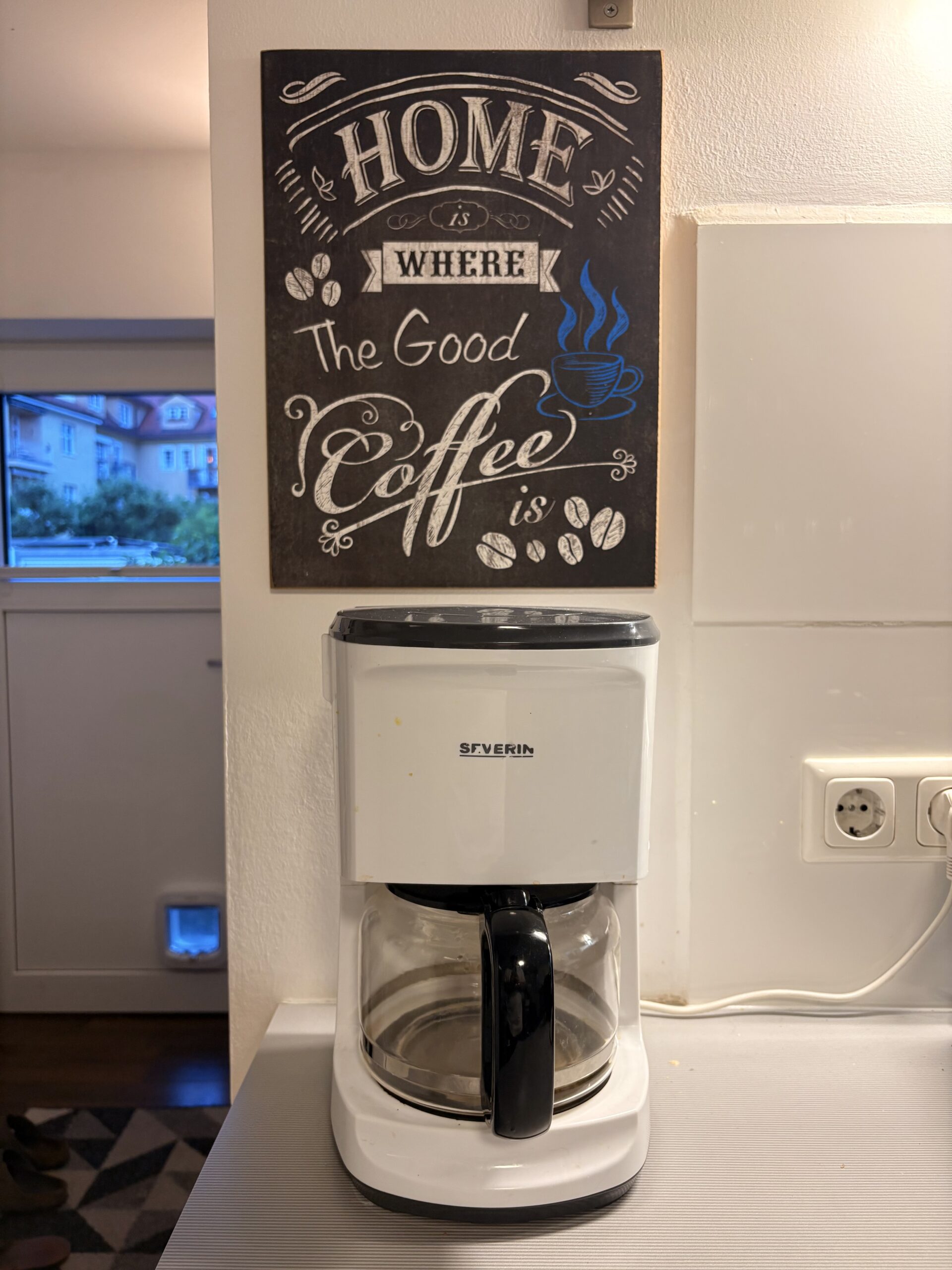
Some years ago, my (now) husband and I moved to our current rental here in Munich. Let’s say that we have quite a good deal given the housing situation in one of Germany’s most expensive cities to live: we have a small house, small enough to have to make compromises to make it work, but with a garden, in a residential street, accessible enough to be in the city centre in 20 mins, while allowing us to be far from the hustle of traffic after a 5-minute jog. The house came furnished, which sounded practical at first, but it turned out to be one of our major headaches. We keep balancing between keeping what’s there and replacing it, knowing we’ll have to leave our investments behind when we move out.
One of the pieces of decoration that was in the house was this, probably a dollar store piece of wood, trying to resemble an early 2010s coffee shop with a very generic message: “Home is where good coffee is”. Now it’s clear I hate the piece of wood, but not to the point of “can’t wait to replace it” because the message is non-controversial. Our visitors may agree or feel neutral towards it, but not disagree. Even if it isn’t true. Until recently, I didn’t drink coffee. Not beyond the sugary Starbucks Frappuccino, with enough toppings to not taste like coffee anymore. I guess I didn’t know what good coffee was.
I’m originally from Colombia, from the Quindío region, famous for its coffee production. As many families in the region, coffee was somehow part of our livelihood. My grandma on my mother’s side married a man who owned a large plantation, where I spent weekends and school breaks. When they grew older, they had to sell it, but unable to stand the life in the village, they convinced my parents to buy a smaller farm, which my grandma and her husband managed until dementia and other health complications kicked in. My grandpa, from my father’s side, worked building machinery and, among other things, the machines for peeling and grinding coffee.
I was always told that coffee from Quindío was very smooth, floral, and fruity. They proudly claim it is the best coffee in the world, but I guess that’s a matter of taste. The coffee I knew from then was only filtered with some sort of sock-like cloth. Also, I didn’t know it could be made just with water. Things may have changed, but I remember coffee was always made with aguapanela, being agua Spanish for water and panela, the local name of a block of brown sugar, which you would usually dissolve into boiling water. So, sugar was always included. I never knew what smooth, floral, and fruity meant.
I grew up unimpressed by coffee. Indeed, seeing my friends and partner needing it just to wake up and function in the morning made me refuse it even more. While living in Spain, already as a teenager, I remember having a thing for café bombón, which is some sort of espresso with condensed milk (almost 50-50), but that went away, just as a summer love. I never even liked the smell of coffee-making, especially the smell of Moka. Call me crazy, but the smell of a Moka pot always reminded me of a cigar. Looking back, I realize why: my first housemates (already in university) used to brew their Moka while smoking cigarettes right out of bed.
Time passed, and I even made it through my PhD without drinking more than an occasional cappuccino with oat milk (Cappuccino mit Hafer, the ladies in the bakery learned I’d take when I slept a bit too little, or knew I was going to have an extra-long day). Every day after lunch at work, my group of friends gathers to have coffee. Every lunch ends with an XL-sized Moka brewing some ten small cups of strong coffee, strong enough to wake a corpse. The ones in charge are Italians, and yes, Italians are always proud of their coffee-drinking culture, as if it grew in their backyard. Italians know a lot about food; I’d always trust a culinary tip from an Italian, so I thought they had to know about coffee. And I thought that if coffee was supposed to be dark and bitter, that I could only drink it in one sip and would make me feel tickles and goosebumps all over my body, maybe it wasn’t for me.
Right after, a new friend from my dinner with strangers told me that the problem is that I had never had good coffee. She took me to a specialty coffee shop here in town, and that’s when my disgrace, a good one, like an obsession, started. We had two coffees, one natural and one washed. I don’t remember the full set of characteristics, but I remember that I didn’t feel goosebumps. Instead, my pupils opened wide, and I took such a deep breath that my brain felt fully oxygenated. Each coffee was a different experience, as if they were two types of tea. I learned that good coffee isn’t bitter, but bright and well-balanced. Balanced between the darker tones (like dark chocolate, cinnamon, and black tea) and the acidity you’d expect from fruits such as berries and citrus.
As with most of the things I do, I decided to go all in with my coffee journey. Learn about it, but also take those five minutes as my me-time. I can still get through my days without drinking a cup, but I understand that making good coffee is an art. An art that requires focus and dedication, which are well-appreciated in this busy life. And that is rewarded with more focus and productivity at work. Sometimes I wonder: “What if I had started drinking coffee during my PhD?” We won’t know the answer for that, but I’ll keep you posted about my process in this section of The Wide Lens Kitchen.
But all this is a work thing; my grinder and good coffee are at the office. At home, we have a dripping coffee machine, and we only have ground blends from the supermarket. When I drink it, I get goosebumps, but it’s the one that helps my husband wake up and be productive, and keeps his migraines away (most of the time). I asked him if we should also get a set and good coffee for home, but he said he wouldn’t appreciate it because all he wants is something he can pour water into, press a button, and use to help him get his day started. For me, it’s alright, because at least then I don’t drink it on the weekends.
We have a lovely home. With its disadvantages, but enough for our family of four (a recently married couple with two cats). It’s a place we work to make our own little by little, because we believe a requirement for happiness and fulfillment is having a safe space to call yours. However, we don’t have good coffee. And that’s okay. Until we find something new, we will keep the piece of wood. I guess it’s better than a print that says “Eat. Pray. Love”.
“Always kiss me goodnight”
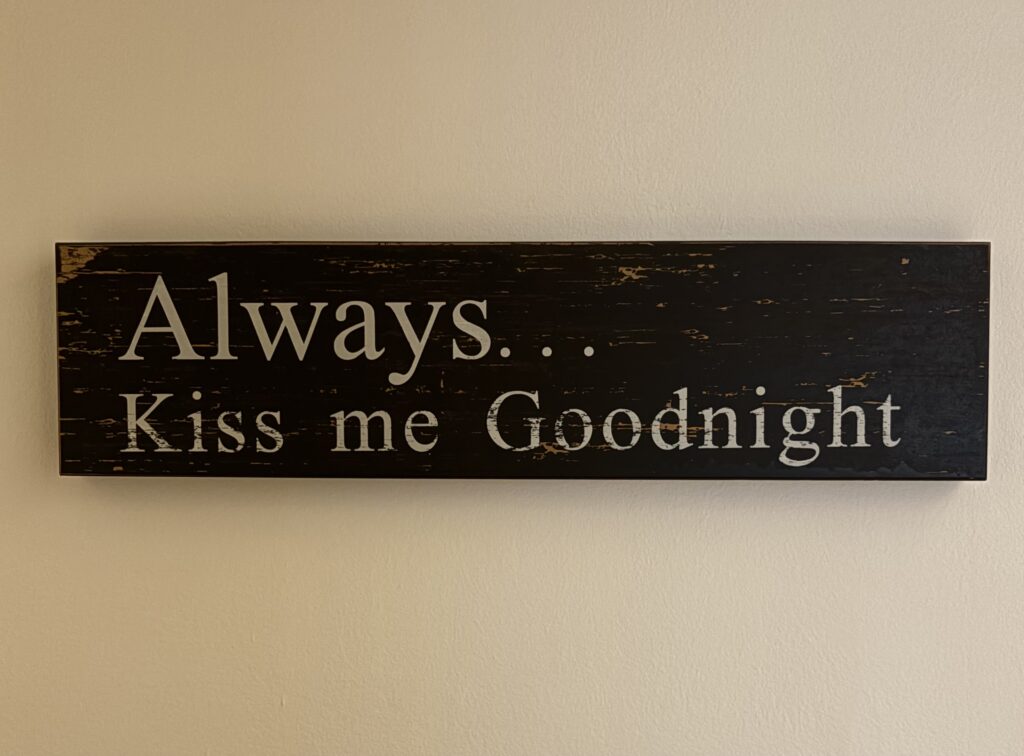
Another piece of art in our rental is a wooden board that says, “Always kiss me goodnight.” It is conveniently placed at the entrance of the bedroom. Because of its hidden location, it generates much less discussion. It is easy to forget it’s there, but of course, when you see it, you think “Who doesn’t want a good night kiss?”. I just wonder who writes these quotes for wooden boards.

I used to have a clock on wooden board in the kitchen of my old apartment that said: ‘beer doesn’t ask questions, beer understands’. In the background, there were coffee beans. It was a masterpiece of nonsense hideous home decor and at some point it was just part of our home!